SendCutSend has shipped more than 30 million laser-cut parts to more than 300,000 customers from three plants in Reno, Nevada, Paris, Kentucky and Arlington, Texas, and until May 2026 it did so on a $750,000 laser financed by its founder, bank loans and credit cards. That month Sequoia, Paradigm and Patrick and John Collison put in $110 million at a $1.01 billion post-money valuation, the company’s first institutional round eight years after Jim Belosic started cutting parts for his own boat projects. For a buyer the interesting number is not the valuation. It is the published schedule: 2 to 4 production days on a laser-cut aluminum bracket, plus or minus 0.005 inch, no minimum quantity, free shipping over $39. This piece covers how SendCutSend built that schedule, what the plants and headcount look like now, the processing-time stack a buyer can plan against, the quantity breaks, the four stock materials by gauge, the $1 billion pledge, and behind the wall, which parts to send and how to price them.
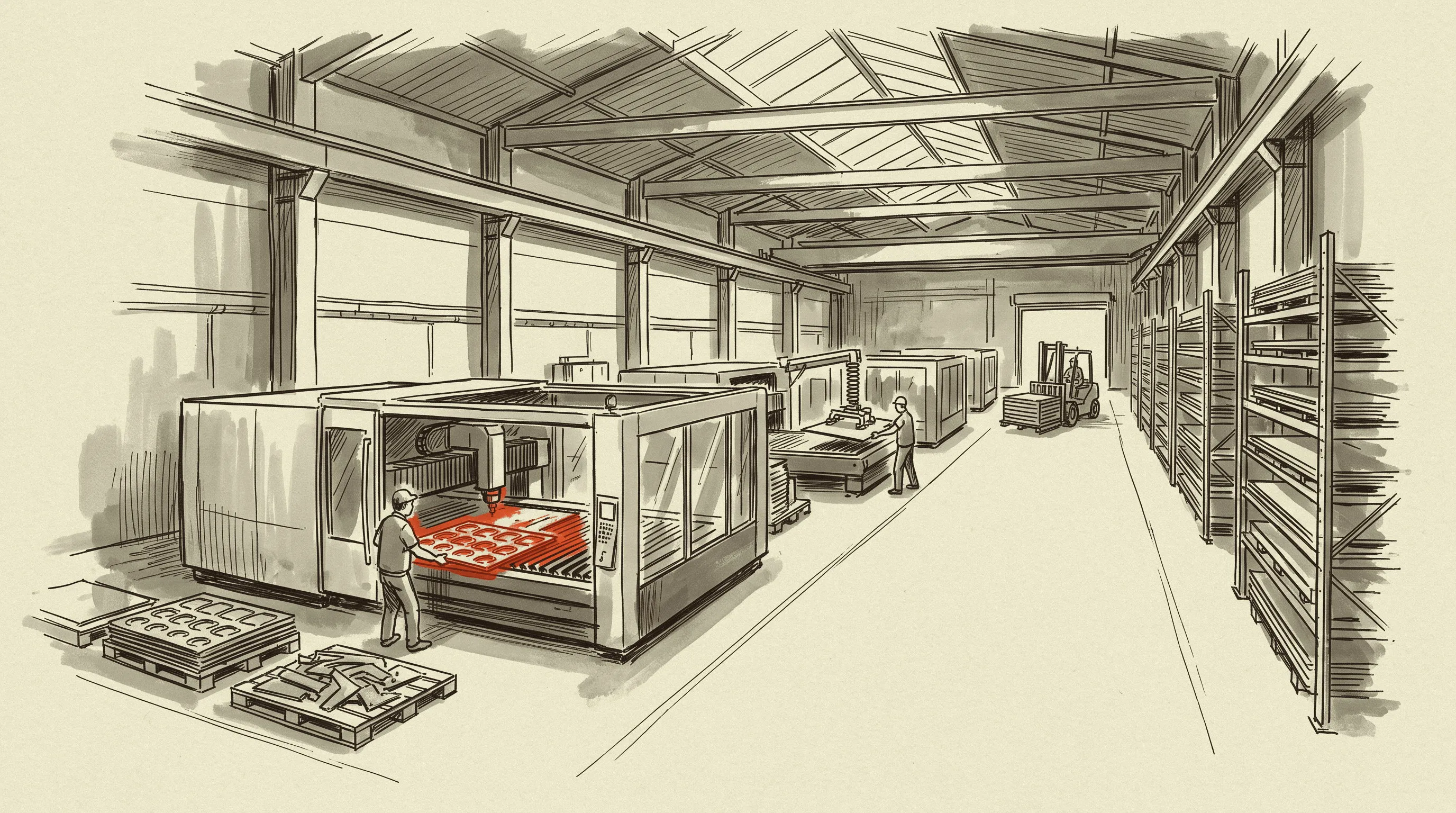
SendCutSend’s laser and CNC routing page says 1 to 3 days and its processing-times page says 2 to 4 for sheet cutting including waterjet. OSH Cut in Orem, Utah publishes 2 business days with a same-day option, Xometry 3 business days standard, Protolabs 3 days for cutting under 0.125 inch and 5 days standard. The 14 to 21 day bar is the comparison Belosic himself draws, as The Hustle reported it: “48 hours vs. 2-3 weeks from China”. The Lead-Time Monitor reads the ISM production-materials lead time at 84 days, so a fabricator that puts single-digit days in writing is doing something the rest of the supply chain does not.
SendCutSend Started With One Laser and a Garage
Jim Belosic had run software companies for most of his working life. He co-founded Pancake Laboratories in Reno, whose ShortStack product built social-media campaigns and landing pages, and he built parts for boats and vehicles in his garage on the side. When the projects outgrew hobby tools and no local shop wanted a one-piece order, he sold his interest in ShortStack and bought an industrial fiber laser. The Hustle puts the first machine at $750,000, financed with his wife’s approval. The company’s own about page gives the founding question: “Why can’t we create an online laser cutting service with the convenience of Amazon?”
The answer was a web page that quotes a part from a CAD file in seconds. A customer uploads a .dxf, .dwg, .ai, .eps, .stp or .step file, or draws the part in the site’s Parts Builder, picks a material and quantity, and the price appears. The company describes the pricing model as “material, quantity, part geometry, and total processing time, plus additional proprietary factors”, with volume discounts up to 80%, savings from the second part, no minimum order and free US shipping at $39. Crunchbase News reported that Belosic funded the company with savings, bank loans and credit cards for its first eight years, and TBPN Digest that it was profitable before the round on about $1,500 a month of Google advertising.
The order flow is the product. The site checks the uploaded geometry against design rules for the chosen material and thickness before it prices, so a hole too close to a bend line or a slot narrower than the kerf comes back as a warning rather than a scrapped part. Orders placed before noon Pacific start the same day, the plants cut seven days a week, and the company’s own record, as The Hustle reports it, is 32 minutes from upload to the shipping dock. The OEM Disclosure Scorecard scores vendors on whether lead time, price and capacity are published, and a web page that prices and schedules a part without a phone call is the top of that scale.
Cumulative revenue passed $100 million in October 2025 and $200 million by the time of the round, on a business that had never taken a venture dollar. The $100 million milestone is from Northern Nevada Business Weekly, which counted 410 employees in January 2026, and the $200 million cumulative figure is as Tech Funding News reported it in May. The one outside cheque before Sequoia was a $6 million friends-and-family round from Sandy Kory and Mark Sugarman.
Ten million parts by March 2024, thirty million by May 2026, so the second twenty million took about two years and the first ten took six. The Hustle’s figure for last year’s output is 8 million pieces, which at that pace means the company is on track to ship more parts in 2026 than in its first five years combined.
Three Plants and a Quarter-Million Square Feet
The first plant outside Reno was Paris, Kentucky, and the state’s own release gives the numbers: a nearly 37,000 square foot building on Cleveland Drive, a $3.9 million investment, 75 jobs at an average of $21 an hour with benefits, opened in December 2021 with up to $800,000 in Kentucky Business Investment incentives over ten years. Belosic’s reason was freight: “The Paris facility allows us to reach more than 50% of the United States in two days with our shipping carriers.” Arlington, Texas followed with 50,000 square feet on 107th Street, and by March 2024 the company had more than 180 employees, a new $1.3 million high-power fiber laser and two more CNC press brakes.
Reno remains the center. Northern Nevada Business Weekly counts 130,000 square feet across three buildings on Longley Lane and nearly a quarter-million square feet in total, and in June 2026 the company was hiring for a fourth Reno building at $24 to $42 an hour for fiber laser, CO2 laser, CNC, press brake, powder coating, anodizing and welding roles, with 100% employer-paid medical and one paid meal a shift. Headcount was “500+” across more than ten states.
130,000 square feet in Reno, 37,000 in Paris, 50,000 in Arlington, and five regions named for the next sites: Pennsylvania, Ohio, Indiana, Las Vegas and Atlanta, at about $600,000 of deposit per location according to TBPN Digest’s account of the raise. Machines are financed separately through JPMorgan, so the $110 million goes to software, people and buildings rather than lasers.
180 employees in March 2024, 410 in January 2026, more than 500 by June, with 200 to 300 more hires planned and the software team to be tripled. Belosic’s hiring line, in the June release, is “We believe great people can learn great skills”, and the Tech Funding News headline put it more bluntly: the company hires from Dollar Tree, donut shops and bars and trains them on lasers. The electricians piece shows what that labor market looks like from the other side.
How the Round Came Together
The introduction came over X. Patrick Collison, who had invested personally, connected Belosic to Matt Huang at Paradigm and Andrew Reed at Sequoia, and Reed, in Belosic’s telling to TBPN, “got on a plane, and within nine hours he was at our facility”. Reed’s public statement in the company release: “Reindustrializing the U.S. will require a hardware ecosystem to emerge, and SendCutSend is at the center of it.” Huang called it Paradigm’s first manufacturing investment and pointed to “intense demand for rapid, on-demand sheet metal and custom parts” from robotics, defense, rocket and electric-vehicle companies.
The customer list explains the interest. The company says 59% of the Fortune 500 have ordered, TBPN’s account has 85% of the top defense primes and names Zipline and Nuro, and The Hustle reports nine of ten private rocket launch companies as customers, alongside high-school robotics teams paying $19.51 for a bracket. Belosic’s own summary to The Hustle: “There has never been a better day to start making something in the US than today.” The Bid-Tab Price Book shows the other end of that market, where public buyers pay for switchgear and gensets in bands, and the contrast is the point: SendCutSend’s price is the same for the prime and the student.
With the money came a pledge. The company committed to $1 billion over five years in US manufacturing jobs and domestically produced materials, with more than $250 million for facility expansion and new hubs. TBPN’s account has 85% of the aluminum already domestic. For a buyer working through the Tariff Exposure Calculator, that line is the one to check: a part cut in Reno from US-melted 5052 sits outside the Section 232 tiers the September 2026 tariff schedule lays out for imported articles. The company’s own bio lists aerospace, defense, space flight, data centers, robotics, automation, transportation, marine, agriculture and distribution as the industries it serves, and TBPN’s account has supply-chain disruptions touching 3 to 4% of customers, which is the exposure a domestic sheet supply is meant to hold down.
The Processing-Time Stack a Buyer Can Plan Against
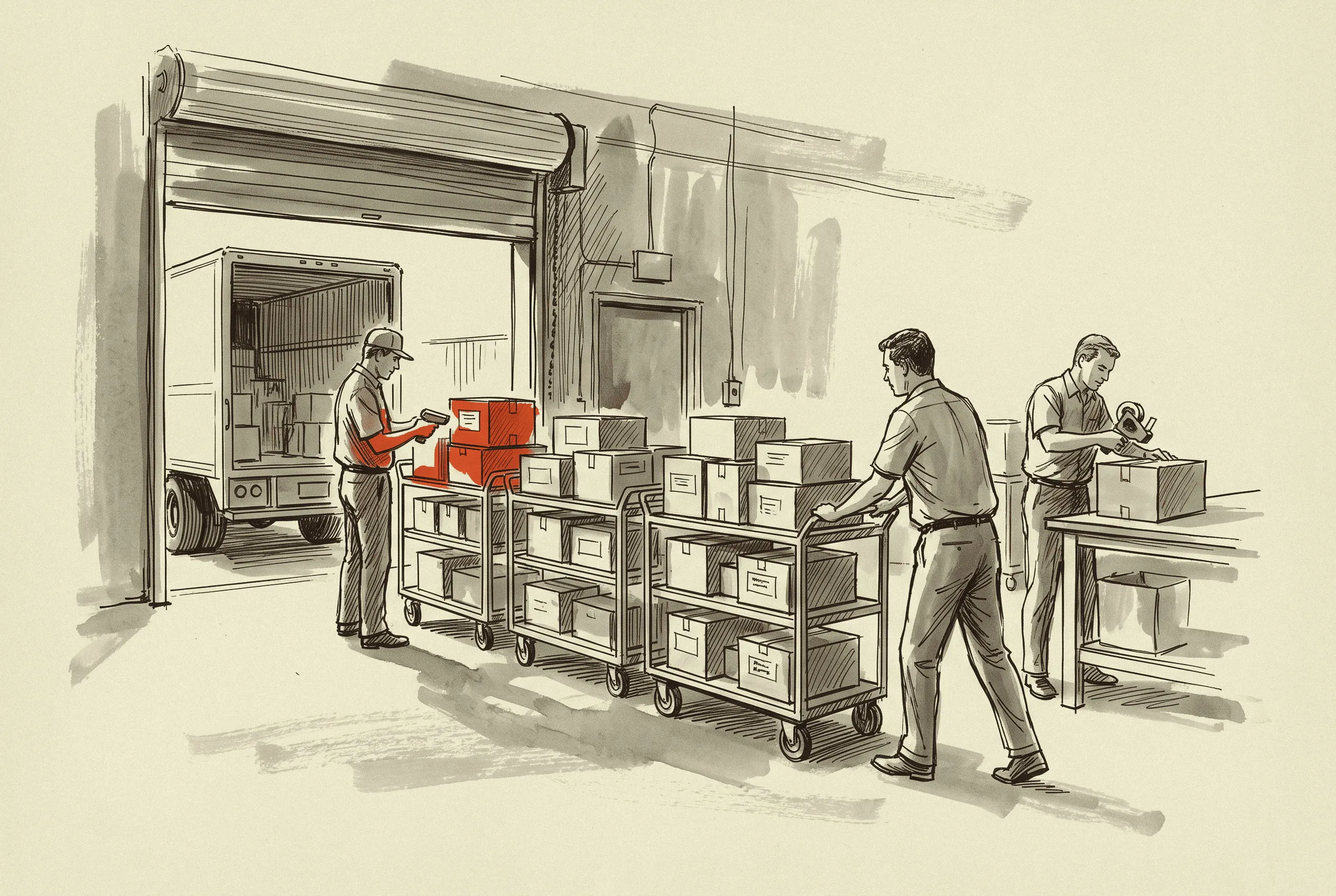
What makes SendCutSend unusual among fabricators is not the laser. It is that the processing-times page states every operation in days and the days add. Sheet cutting is 2 to 4 days and CNC machining 2 to 5. Bending, tapping, countersinking and tumbling add 1 to 2 days each, hardware insertion and dimple forming 1 to 3, powder coating 3 to 5, anodizing 1 to 7, plating 7 to 10. Orders of 100 or more parts add 2 to 4 days, parts over 46 inches add 1 to 2, orders over 80 pounds add 1 to 2 for packaging, and orders needing more than 40 square feet of material add 2 to 5 depending on stock. The cutoff is noon Pacific, Monday to Friday, and the plants cut seven days a week.
A flat laser-cut part ships in 2 to 4 days. Add a bend and a tapped hole and it is 4 to 8. Add powder coat and it is 7 to 13. The Hustle reports a standard 48-hour turnaround inside the company and a fastest-ever order of 32 minutes from upload to the shipping dock. That schedule is what the Quote Check tool compares a local fabrication quote against, and a local shop that quotes three weeks for the same bracket is quoting its queue, not its process.
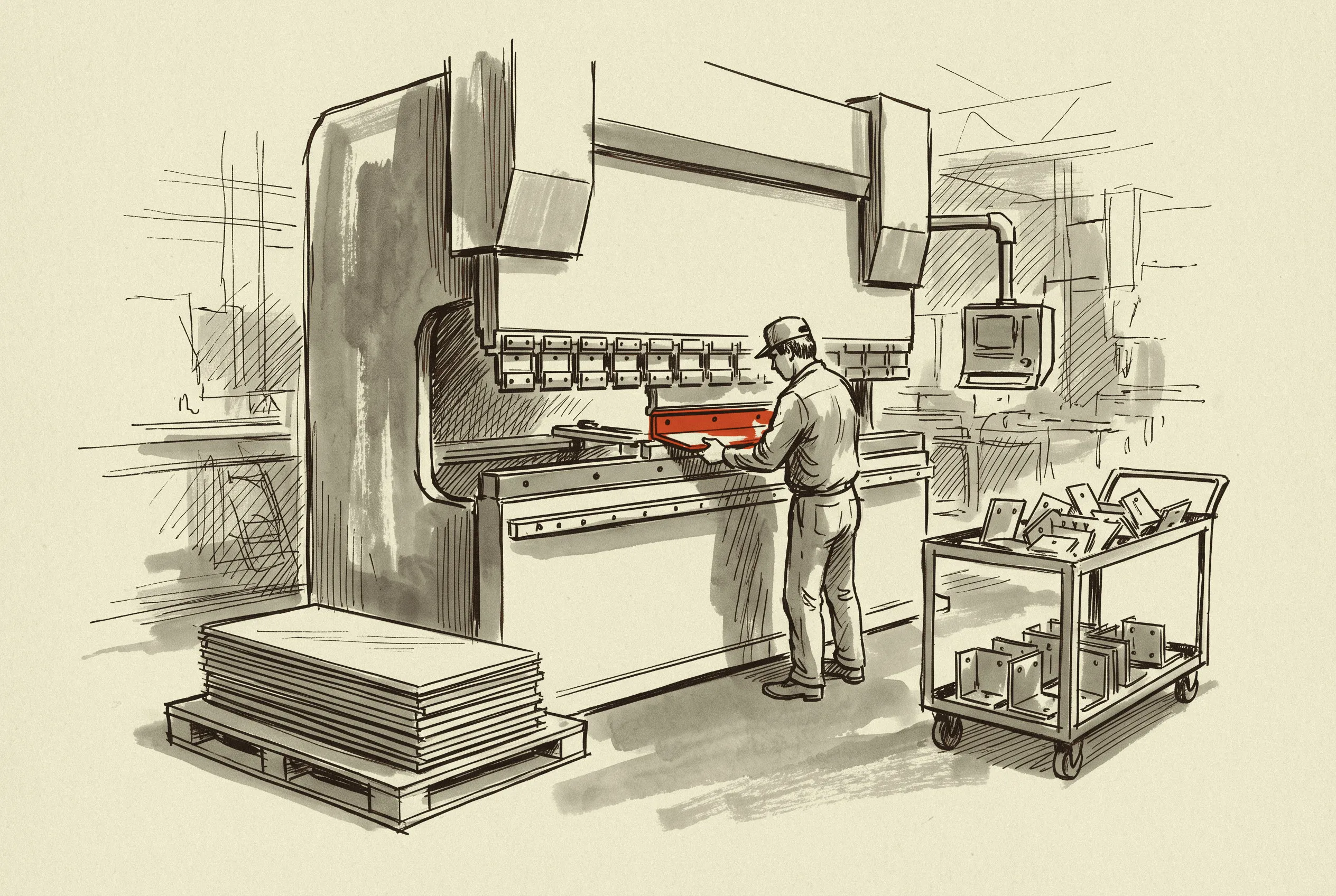
Every operation has a tolerance and every tolerance is on the page: plus or minus 0.005 inch on laser and CNC routing, plus or minus 0.009 on waterjet, an automatic 0.010 inch edge break on machined parts, and a 0.002 to 0.005 inch per side powder-coat build. The sheet-cutting page lists more than 175 materials from 0.015 to 2.25 inches, the CNC machining page offers 3-axis, 3+2 and 5-axis work in 6061 from 1 x 1 x 1 to 7 x 7 x 12 inches, and the powder-coating page gives 15 colors on seven metals up to 30 x 36 inches flat. A buyer who has spent a week getting a tolerance in writing from a job shop, as the RFQ guide describes, will notice that here the tolerance is the default.
Four Stock Materials, 38 Gauges, One Price Curve
The aluminum menu is the one most machine shops will use. 6061-T6 comes in 12 thicknesses from 0.040 to 0.750 inch, 5052-H32 in 11 from 0.040 to 0.500, and 7075-T6 in three, 0.125, 0.190 and 0.250. Mild steel runs 12 gauges from 0.030 cold-rolled 1008 to 0.500 hot-rolled A36. Instant pricing covers sheets to 30 x 44 inches and custom quotes reach 41 x 56 on 6061. Where the plate gets thicker than the laser, the Nox Metals piece picks up: that company saws 6061 and 7075 plate from 0.25 to 24.5 inches in Detroit, and Belosic had its founder on his podcast.
Twelve gauges of 6061, eleven of 5052, three of 7075, twelve of mild steel, all at plus or minus 0.005 inch and all at 2 to 4 production days. The Equipment Price Benchmark collects delivered price per part on cut sheet so that a buyer can see where an uploaded bracket lands against others of its size.
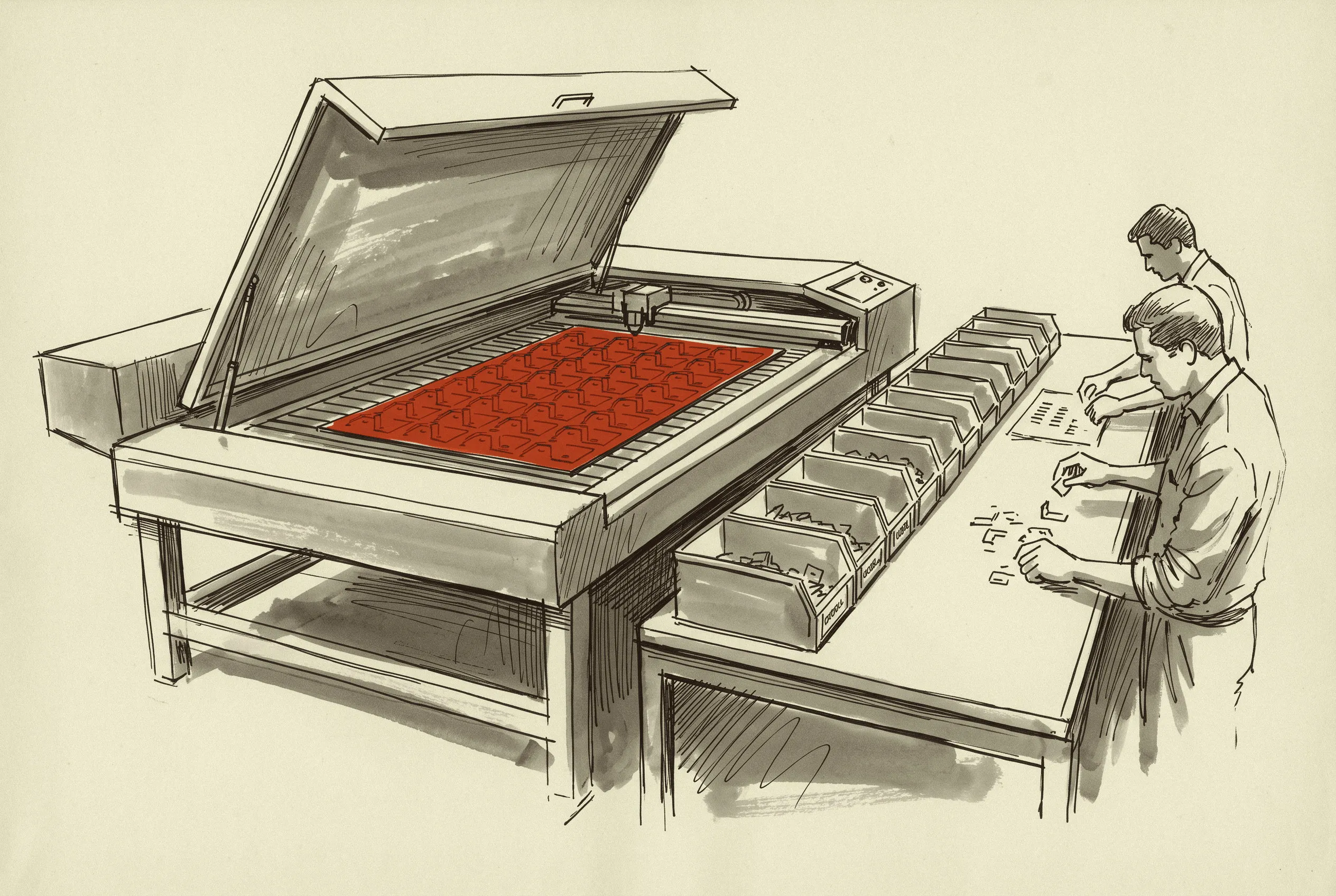
The price curve is steep and published. The sheet-cutting page’s example aluminum part is $9.90 each at quantity one and $3.70 at one hundred. The powder-coating example is $20.69 at one and $3.31 at one hundred. The pricing page shows a 1.5 x 3 inch part at $19.51 in hardboard, acrylic and 0.187 inch 5052 alike, and marks all of these as estimates that move with the material tape.
$9.90 to $3.70 is a 63% drop, $20.69 to $3.31 is 84%, and the site’s stated ceiling is “up to 80% off in bulk”, which the powder-coat example exceeds. The arithmetic is in data/assumptions.csv. A buyer who batches a month of brackets into one upload of a hundred pays roughly a third of the single-piece price, and the Copper and Wire Price Sheet shows how much of the remaining cost is metal tape rather than labor.
What SendCutSend Means for a Job Shop
The obvious reading is that SendCutSend competes with the local fabricator. The better reading is that it is the local fabricator’s supplier. Belosic told The Hustle the model is a high-mix, low-volume job shop running 24 hours a day with “backup machines for backup machines”, and a shop with one laser and one brake can send its overflow, its odd materials and its one-off prototypes to Reno and keep its own machines on the work that pays. We priced a cobot welding cell at $113,336 in the robot cell piece. The fixtures and guarding brackets for that cell are exactly the parts that come back from SendCutSend in a week, and the Bid-Tab Price Book worked example prices the rest of the cell. The Factory Automation Roadmap tracks where the cells go.
The disclosure is also unusual for its completeness. Turnaround, tolerance, material list, sheet size, quantity curve, cutoff hour and shipping threshold are all on public pages, which is more than most switchgear or chiller OEMs put in writing, as the OEM Disclosure Scorecard shows. The one thing a buyer still has to ask for is a certificate: material certifications on cut parts are handled by request, and a shop supplying a defense prime should confirm the melt origin on the order, since TBPN’s 85% domestic aluminum figure means 15% is not.
What to Do Monday
Upload the bracket you order most. Take the .dxf your local fabricator has quoted, put it through SendCutSend’s instant quote in 5052 or 6061 at your usual quantity and at one hundred, and write down three numbers: the price per part at each break, the production days from the processing-times page, and the delivered date after the noon Pacific cutoff. Put the local quote beside it through Quote Check and the price per part into the Equipment Price Benchmark.
Then look at the calendar, not the price. The Lead-Time Schedule turns the 2 to 4 day figure plus adders into a promised dock date you can hold a supplier to, and the 171-day capex piece explains why a fabricator that publishes days is worth more than one that beats a price by 5% and ships in a month. For thick plate above 0.75 inch, send the cut list to Nox Metals instead, and for a machine to run the parts on, the Haas VF-2 piece has the number.
Behind the paywall: the parts SendCutSend fits and the ones it does not, a worked bracket priced at three quantities with the 7 to 13 day schedule attached, the file-preparation rules that keep an order out of the revision queue, and when a local fabricator still wins. The Lead-Time Monitor fabrication rows are in data/turnaround-ladder.csv.