ModelVersion 0.1Compiling data
Large-Load Cost Table
What a 50 MW connection costs and takes in 15 US markets: study fees, security per MW, minimum bills, contract terms, exit fees and realistic energization year, from tariffs and dockets.
2033realistic energization year for a new 50 MW load in Northern Virginia, Dominion Energy, from a 2026 application. Public headline as of August 21, 2026.
- $75M
- Collateral for 50 MW under Dominion Schedule GS-5 at $1.5 million per MW, LBNL and Brattle brief, August 10 2026
- 14 years
- Dominion GS-5 minimum term including a four-year ramp; AEP Ohio DCT up to 12; Georgia Power up to 15
- 85%
- Minimum bill as a share of contract demand, Dominion GS-5 (distribution and transmission) and AEP Ohio DCT cap
- 15
- Markets side by side, each cell linked to the tariff sheet, PUC order or ISO document it came from
What it covers
Fifteen US markets for a 50 MW connection: Northern Virginia (Dominion), Columbus (AEP Ohio), Atlanta (Georgia Power), Dallas-Fort Worth (Oncor), Houston (CenterPoint), West and South Texas (AEP Texas), the Carolinas (Duke), Phoenix (APS and SRP), Salt Lake City (Rocky Mountain Power), Louisiana (Entergy), Colorado (Xcel), Chicago (ComEd), the Bay Area (PG&E) and Northern Indiana (I&M). For each: MW threshold, whether the rule applies at 50 MW, study fee, security or collateral in dollars, minimum bill, contract term, ramp, exit fee, CIAC exposure and the realistic energization year with its basis.
- Cadence
- Updated as dockets move; reviewed monthly; energization years revisited each quarter
- Compiled from
- Utility tariff sheets and PUC orders (Virginia SCC PUR-2025-00058 and PUR-2026-00056, PUCO 24-508-EL-ATA, Georgia PSC docket 55378, PUCT Projects 58480 and 58481, Oregon PUC Order 26-154, CPUC D.25-07-039); ERCOT large-load status decks; PJM BRA results; the LBNL and Brattle large-load rate-design brief (August 2026); EIA industrial rates by state; JLL Global Data Center Outlook 2026 for time to power
- Delivered as
- Excel workbook, Web dashboard
- Updates
- Quarterly updates, one year included
- Onboarding
- Onboarding call
- Support
- Ad hoc analyst calls
- Tier
- Table free; history Pro; alerts Institutional
Who uses it and what it decides
- Datacenter developers and site selectorsWhich market energizes first, what the deposit per MW is, and how much cash a portfolio has locked in security.
- Factory owners adding 20 to 100 MWWhich regime a plant expansion lands in (below Texas's 75 MW, above AEP Ohio's 25 MW, inside Georgia's 100 MW rule) and what that costs.
- Lenders and investorsMinimum-bill and exit-fee exposure over a 12 to 15 year term, market by market.
Methodology
What the headline is
2033 is the year a 50 MW load applying to Dominion Energy Virginia in 2026 can realistically expect to energize. The basis is JLL’s Global Data Center Outlook 2026 (p.18), which puts Northern Virginia at about seven years to power for a new 50 MW site, and Dominion’s own load pipeline of about 70 GW against a 24.6 GW system peak as reported by Utility Dive in February 2026. The shortest markets in the table (Houston, Northern Indiana, Salt Lake City) are 2028 to 2029. The full column with its basis is in energization-years.csv.
The headline is the longest realistic energization year among the 15 markets. It moves when a utility publishes a schedule that changes it.
What it is compiled from
Version 0.1 is tariffs, orders and ISO documents. No developer interviews yet.
- Virginia. Dominion Schedule GS-5 approved 25 November 2025 (PUR-2025-00058): 25 MW threshold, 14-year term with a four-year ramp, 85% minimum for distribution and transmission and 60% for generation, $1.5 million per MW collateral. Mandatory CIAC for direct-connect transmission ordered 31 July 2026 (PUR-2026-00056 final order). Terms as summarised in the LBNL and Brattle brief, pp.4 to 7.
- Ohio. AEP Ohio Schedule DCT, approved 9 July 2025: $50,000 study fee for 50 to 100 MW, 85% minimum, ramp plus eight years, 36-month exit fee, collateral of 50% of term minimum charges. 17,861 MW under contract at February 2026 against an 8,000 to 10,500 MW peak. Tariff page.
- Georgia. PSC rule of 23 January 2025: 100 MW and above, contracts up to 15 years, upstream cost recovery.
- Texas. SB6 (signed 20 June 2025, 75 MW threshold); PUCT proposed 16 TAC 25.194 (12 March 2026): $50,000 per MW security plus $50,000 per MW fee; ERCOT Batch Zero approved 18 June 2026 with 438 GW tracked; the Governor’s 3 August 2026 audit directive at 474 GW.
- Oregon, Colorado, Indiana, Carolinas, California. PUC Order 26-154 (PGE Schedule 96, 10 to 30 years); Xcel’s April 2026 filing; I&M’s Cause 46097 settlement; Duke’s HLF proposal; CPUC D.25-07-039 and PG&E Rule 30.
- Capacity and rates. PJM BRA clearing prices from the 2028/29 results report; EIA Table 5.6.A industrial rates (Texas 6.58 cents per kWh, Virginia 9.31, Ohio 9.89, June 2026).
Every cell prints its verification status: VERIFIED against the primary document, or SECONDARY with the outlet named.
What is free and what is paid
- Free: the 15-market table as published in What 50 MW Costs in 15 US Markets, this page, and the Large-Load Interconnection Cost calculator with default inputs.
- Pro: the table’s history as dockets move, the 20 MW and 100 MW scale factors, and the minimum-bill cash schedules by market.
- Institutional: the workbook and dashboard, docket alerts when a cell changes, custom markets, quarterly updates for a year, an onboarding call and ad hoc calls.
Articles built on it
What 50 MW Costs in 15 US Markets, The 2 MW Plant Service Upgrade Nobody Budgets Right, A Factory Owner’s Guide to the PJM Capacity Charge and Datacenter Construction Is Eating Your Electricians. The rule calendar lives on the Large-Load Policy Tracker.
Version history
- 0.1 (August 2026). Fifteen markets. Tariffs and orders through 20 August 2026 (PUCT good-cause exception for ERCOT). Study fees and exit-fee amounts not published for Dominion; cells say so.
What version 1 adds
Developer interviews on actual study outcomes and actual energization dates against the tariff’s promise, and the utility’s study-queue position where a utility publishes one. Interview counts print here only when true.
Known gaps
Dominion’s study fee and exit-fee amounts were not in the sources opened. CenterPoint and ComEd security figures are implied averages from company statements (about $64,000 and $250,000 per MW), not tariff sheets, and are marked as such. Texas’s $50,000 per MW security is a proposed rule and does not apply at 50 MW. The table carries the 75 MW case beside it.
Questions
Why 50 MW?
It is the size most new tariffs are written around (median threshold 25 MW across 55 tariffs in the LBNL and Brattle brief) and it sits under Texas's 75 MW line, which makes the regimes comparable. Scale factors for 20 and 100 MW are in the Pro table.
How is the energization year chosen?
From the utility's or ISO's own statements where they exist (ERCOT Batch Zero dates, CenterPoint's 2029 plan, AEP Ohio's contract schedule) and from JLL's 2026 market-by-market time-to-power figures where they do not. The basis is printed beside every year.
Does the table include the capacity charge?
PJM markets carry the BRA clearing price ($333.44 per MW-day for 2027/28, $325.00 for 2028/29) as a separate column. The PJM Capacity Charge Estimator does the bill arithmetic.
Free calculators built on this model
Articles built on this model
Modular Is Not Cheaper: A 50 MW Prefab Electrical Room, Line by Line
Austin Energy paid Crown Texas $725,183 for one prefabricated 16 by 60 foot control house in June 2023. The house was $489,270 of that. The truck was $12,500, the stairs shipped separately for $5,000, and the crew that unloaded and anchored it billed…
What 50 MW Costs in 15 US Markets
A 50 MW connection requested in Northern Virginia this quarter energizes in 2033, after posting $75 million of collateral and signing for 14 years. The same 50 MW in Houston posts no rule-mandated security, signs no minimum-take contract, and can be live in…
Liquidated Damages at 0.5% a Week: Why Caps Sit at the Vendor's Margin
A week of delay on a 50 MW datacenter hall costs about $2.7 million. The liquidated damages clause in the transformer contract behind that hall pays back $74,000 for the same week, and stops paying after ten weeks. On a 2 MW plant the ratio is worse:…
How to Write an RFQ for Capital Equipment in 2026
The City of Ocala, Florida agreed to pay $8,070,340 for two 105 MVA autotransformers in August 2023 and approved $9,170,340 for the same two units on April 28, 2026, seven months before the first one arrives. The $1.1 million difference is one clause: a PPI…
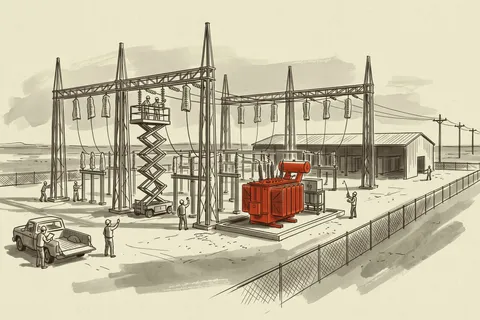
The 2% Funnel: 474 GW Requested, 9 GW Approved, 5.8 GW Energized in ERCOT
Governor Abbott's August 3, 2026 letter to the PUCT and ERCOT put the number at "approximately 474 gigawatts of requests to connect to the Texas grid," more than five times ERCOT's 85,508 MW peak record, about 90% of it data centers. ERCOT's own status table…
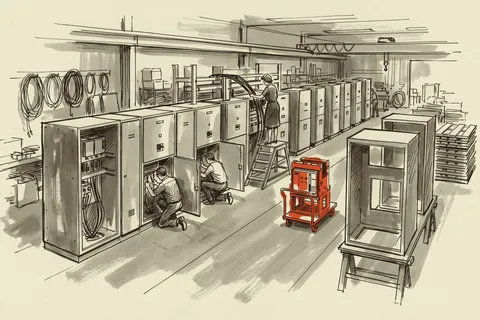
Reading a Switchgear Quote: The Eleven Line Items That Hide the Schedule
Riverside Public Utilities paid $2,561,551.88 for one 15 kV metal-clad switchgear lineup in June 2024, and the unit was still in the factory eighteen months later. The board memo that approved the purchase put delivery in the first quarter of 2026; the next…
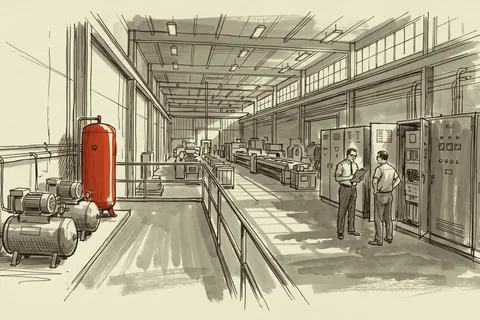
A Factory Owner's Guide to the PJM Capacity Charge
A 5 MW plant in Met-Ed territory will pay about $568,000 for capacity in the PJM delivery year that starts June 1, 2026. In the year that started June 1, 2024 the same plant, with the same load, paid about $50,000. Nothing on the plant floor changed. The RTO…
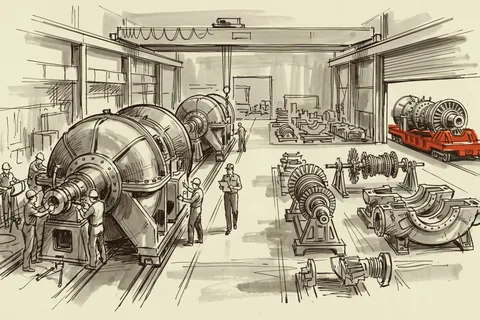
The $60 Million Deposit: How Equipment Slots Became Datacenter Currency
One GE Vernova 7HA.02 is 384 MW. At the ~$790/kW that BNP Paribas estimates GE Vernova is now getting for a heavy-duty turbine (July 2026), that one machine is ~$300 million of equipment, and the 20% reservation payment that holds a production slot for it is…
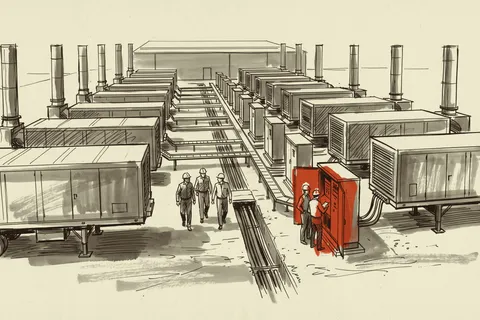
Behind the Meter, In Front of the Queue: 90 GW Announced, 2 GW Running
Datacenter developers have announced about 90 GW of behind-the-meter generation across 59 US projects, and about 2 GW of it runs, which is 2.2%. Another 1.2% is under construction, 36% holds an air permit, and 60% exists as a press release. The same month…
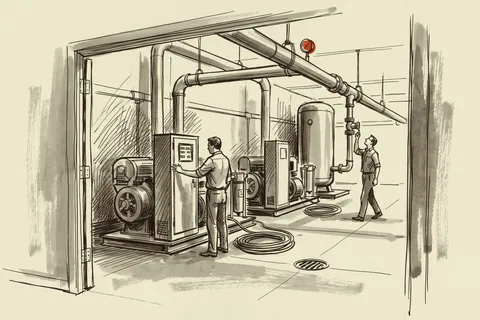
Compressed Air Is 10% of Your Factory's Power Bill
A 200 hp rotary screw compressor running 6,000 hours a year at the 2025 US industrial rate of 8.62 cents per kWh costs about $70,000 a year in electricity, and over ten years it costs about $1.0M, of which $700,000 is the power bill. The DOE's own tip sheet…
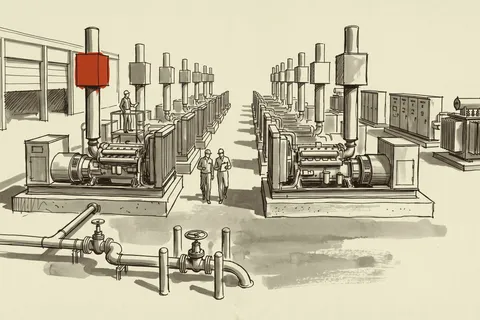
Recips vs Turbines vs Fuel Cells for a 100 MW Bridge
A 100 MW bridge plant run for five years costs $96 per MWh on solid oxide fuel cells, $104 on gas reciprocating engines and $112 on aeroderivative gas turbines. That is at 85% utilization with gas delivered at $3.78/MMBtu, and the ranking holds at every gas…
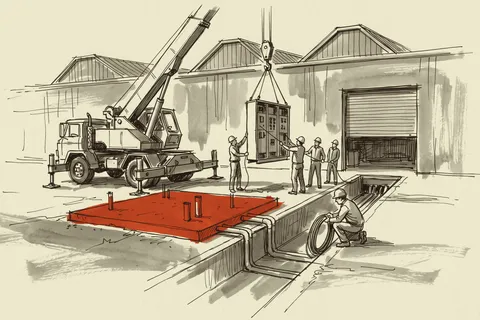
The 2 MW Plant Service Upgrade Nobody Budgets Right
A 400-person plant adding 2 MW of service pays for five things the switchgear quote never mentions, and together they run $400k to $1.2M with one month of bridge power. The calendar is worse than the money: run the project the way most plants run it, utility…

1872, Foundational Industries and Hadrian: Three Blueprints for the Autonomous American Factory
Three companies are building the autonomous American factory from three directions, and between July 2025 and August 2026 they raised $1.41 billion to do it. 1872 took $15 million to run robotic steel fabrication out of a 1903 building in Cincinnati.…
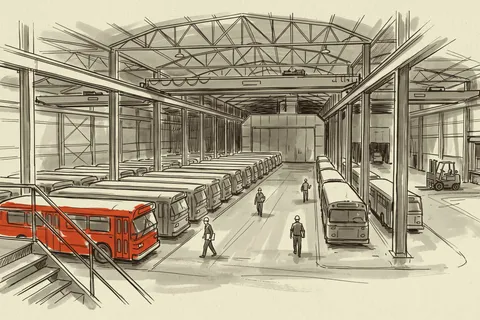
Who Bought the EV Plants' Machines
Companies cancelled, closed or downsized $34.8 billion of US clean-energy projects in 2025, 61 of them, against $12.3 billion of new announcements, and EV and battery plants were more than $21 billion each of the loss. That is E2's count, and it is the wrong…
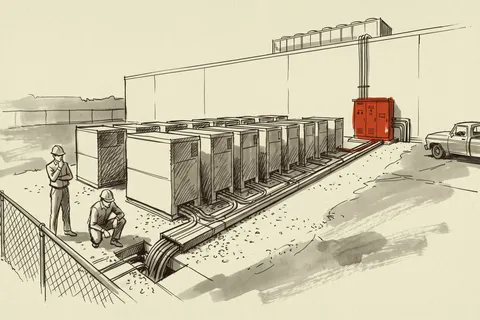
When a Megapack Beats a Static UPS
A 24 MW, 48 MWh block of twelve Tesla Megapack 2 XL units costs about $14.4 million installed at January 2026 prices, $10.1 million after the 30% storage credit, and the N+1 static UPS it would sit next to in a 20 MW hall costs about $17.5 million. A grid…
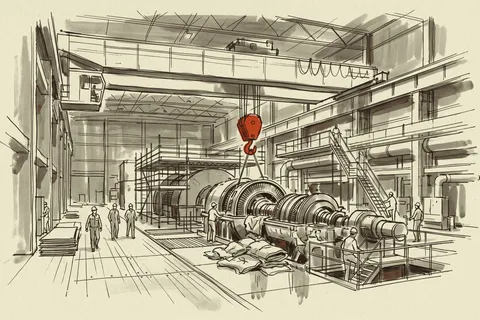
What Hyperscaler Nuclear PPAs Tell a Factory Negotiating a 15-Year Contract
Microsoft is paying about $112 per MWh for 835 MW from a reactor that shut in 2019, and it signed for 20 years. That is the Jefferies estimate for the Crane restart, published five days after the deal, and Bloomberg Intelligence put it at $100 (Bloomberg,…
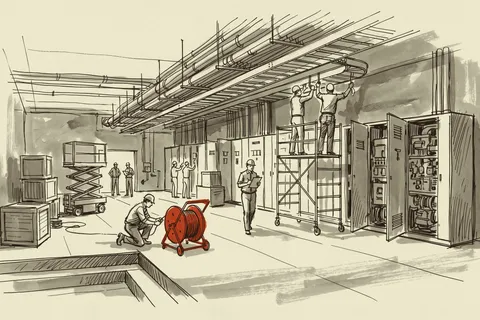
Datacenter Construction Is Eating Your Electricians
Loudoun County's electrical contractors had 5,615 people on payroll in 2019. In the fourth quarter of 2025 they had 13,352, and by March 2026 14,022, a 138% increase in six years. That is what a few gigawatts of datacenter construction does to one trade in…
The 30% Fuel-Cell ITC Is the Last Federal Subsidy for On-Site Power
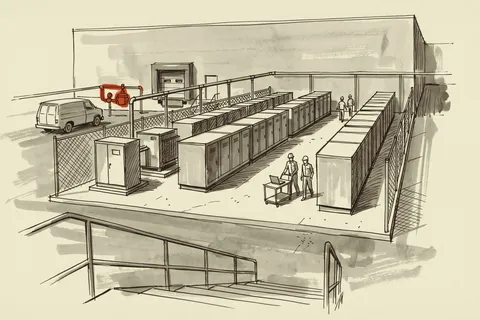
On July 4, 2025, Congress cut the federal investment credit for every kind of on-site generation a factory can buy except one. Wind and solar lose it unless construction starts by July 4, 2026. Gas engines and turbines never had it. Natural-gas fuel cells,…
Transformer Lead Times Hit 143 Weeks: Who Gets Delivered First
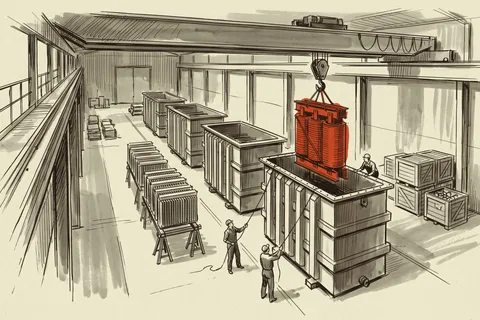
A generator step-up transformer ordered in the United States in the second quarter of 2025 was quoted at 143 weeks on average, per Wood Mackenzie's T&D supply chain survey published October 15, 2025. A substation power transformer was quoted at 128 weeks and…
Introducing the Large-Load Cost Table: 15 Markets Side by Side
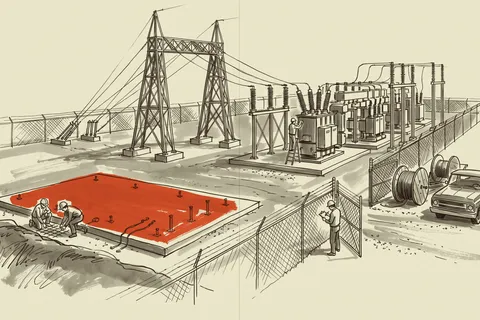
Fifteen utilities, eight tariff cells each, and 45 of the 120 cells have no published number. That is the honest headline of the Open Factory Large-Load Cost Table, which launches as version 0.1: for a 50 MW connection in fifteen US markets, the study fee,…